|
|
Around the time of my mid-life crisis (what an excuse that
is!) I bought a new Buffet E13 Bb soprano. Soon afterwards
I discovered alto clarinets and the sopranos, which had
always been a bit small for my clumsy fingers, had to take
second fiddle (as it were). I kept the E13 as a good
reference for the stranger ones I seemed to be picking up,
until what d'ya know! A 'phone call out of the blue
and now hopefully an advanced student is enjoying a nice
clarinet that deserves to be used.
I swapped some bass bits for a 'Console', a lovely
little plateau keyed extended simple system soprano, silver
plated. Console_Bb
Even more silver plated was a Conn
'Continental' clarinet made of solid nickel silver which had been
shot blast before plating, giving it a lovely satin sheen.
Good quality with grub screw locks on all the post
spindles; typical of a Conn but I know nothing about it at all.
Has cleaned up very prettily and plays just like a real one!
I was actually very impressed with the way it played,
lighter than the E13 but rigid and solid feeling giving lots
of confidence. I reckon it sounded better than the
Buffet. Apparently more metal clarinets were made prior to
WWII than wooden ones, plastic not being in production then.
A lot of good players used them. See Metal clarinets Continental Bb
Continental LHS
Continental
springs
Because of the alto clarinets changeover speaker hole
system I was intrigued by a Bb Leblanc ?? with the same
arrangement. Leblanc say it was the pro. model made in
March 1955, but have no more information! Any info
gratefully received. Leblanc_Bb_chipped_F
Leblanc_Bb_fraising a tone hole
Leblanc_Bb_tone holes before
A very interesting challenge came when I was asked to
repair some 19th century rosewood clarinets. The work
involved rebuilding some of the integral wooden key
pillars, making new keys and flat springs. The springs were
fashioned by reducing brass sheet about 60% in section by
hammering and rolling to work harden it, then cutting to
shape. Not as good as modern steel springs perhaps but
authentic and quite OK for occasional use. Typical flat
spring Flat
springs in progress Rolling flat
springs 10 key clarinet in
pieces RS_1830 10
key clarinet 1830 Goulding
Goulding_hinge_pin
Goulding
machining hingepin
A Lucien Bassi Bb wooden soprano with full Boehm system, a
forked Bb, low Eb and articulated C#/G# with extra LH low
G#/D#. Interesting, and a good excuse for getting my
fingers in a knot. Full_Boehm
Full
Boehm tonehole machining
A pair of Lucien Bassi, Bb & A, in a professional
double case. Short barrels for high pitch but actually I
get them more in tune with a 67mm barrel giving A=440Hz
standard. A nice comparison with the above extended Boehm.
Shame I can't play well enough to appreciate the
subtleties. Lucien Bassi
pair
A Normandy which I understand is a renamed Noblet for the
American market so a good honest instrument to put in nice
condition for my talented grand-daughter. Normandy_Bb
Here are some links to pictures of various other sopranos I
have refurbished;
Ledoux_Bb Pedlar Vito_Bb_7213
Two or three years ago I had a hankering to find out the relative differences between some of the famous clarinets. The ones that were accessible and of particular interest to me were the 1930 -1960 Selmers which would have been available to the famous clarinetist's like Goodman, Shaw, Herman and so on. So I dug out three models that would have been tried out by these great men, Goodman at least having been recorded as playing each, at least long enough to be used as advertising.
First a 1930's RI (Radio Improved)
Second a 1950's Centered Tone
Third a 1960's Series 9 with typical Selmer hard slippery keys that I can't believe are anything but chrome plated.
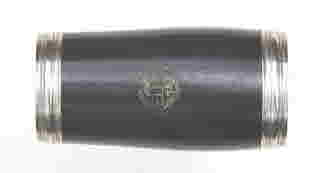
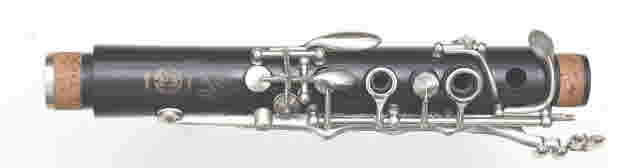
Here are a dozen 80K pictures of these three plus my Leblanc Pro.The only differences that you might not spot from the pictures were that the Series 9 had a little extra compensating key integral with the E key and thus the lower stack Eb, and the LeBlanc had smaller toneholes than the Selmers but with more fraising. I didn't measure toneholes or fraising as it means nothing to anyone but the designer, especially as the bore dimensions I could report would be barely more accurate than the 0.1 ovality/distortion I found in many places. Ovality in itself is of no concern as is is the area that matters rather than the shape. Further, I didn't record the lower joint figures as all my reading tells me that lower joints are always parallel (at least over this time span), and that is what I found. The start of the bell flare also seemed to be about at the same position on the clarinets in hand.
RI is the Radio Improved, CT the centered Tone, S9 the Series 9, LE the Leblanc, R13 the Buffet R13 1950, SR the Selmer Recital 1989
 |
 |
||||
| RI | 14.8 | 14.8 | 14.9 | 14.9 | 14.8 |
| CT | 15.15 | 15.0 | 15.0 | 15.0 | 15.0 |
| S9 | 15.4 | 15.3 | 15.3/15 | 14.9 | 14.8 |
| LE | 15.2 | 15.2 | 15.0 | 15.1 | 14.9 |
| R13 | 14.95 | 14.92 | 14.94 | 14.83 | 14.64 |
| SR | 14.87 | 14.75 | 15.15 | 14.83 | 14.62 |
The figure at the middle of the top joint was in fact
40mm down from the upper joint line. The Series 9 seems to have negative taper
which closes quickly after the first joint from 15.3 to 15 over 10mm then slowly
down to the end of the joint. The Leblanc appears to bulge in the upper
part of the joint. The earlier instruments have parallel bores. In perusing my
reference books for some pertinent summary remarks I have yet again concluded
that there are none; the whole subject of woodwind acoustics being the
proverbial 'can of worms', fascinating but irresolvable. The data for the Buffet
R13 and Selmer Recital was slightly interpreted from O. Lee Gibsons grand little
book 'Clarinet Acoustics' which gives a comprehensive outline of the complexities
of clarinet design in a short enough form to read without too much headache.
There's always Benade if you want to get a serious headache, but what a wealth
of wonderment to explore! If you don't know of him, his 'Fundamentals of Musical Acoustics'
is the holy grail.
What better place to end.