Click on any picture for a larger version in a separate window, or on links in text.
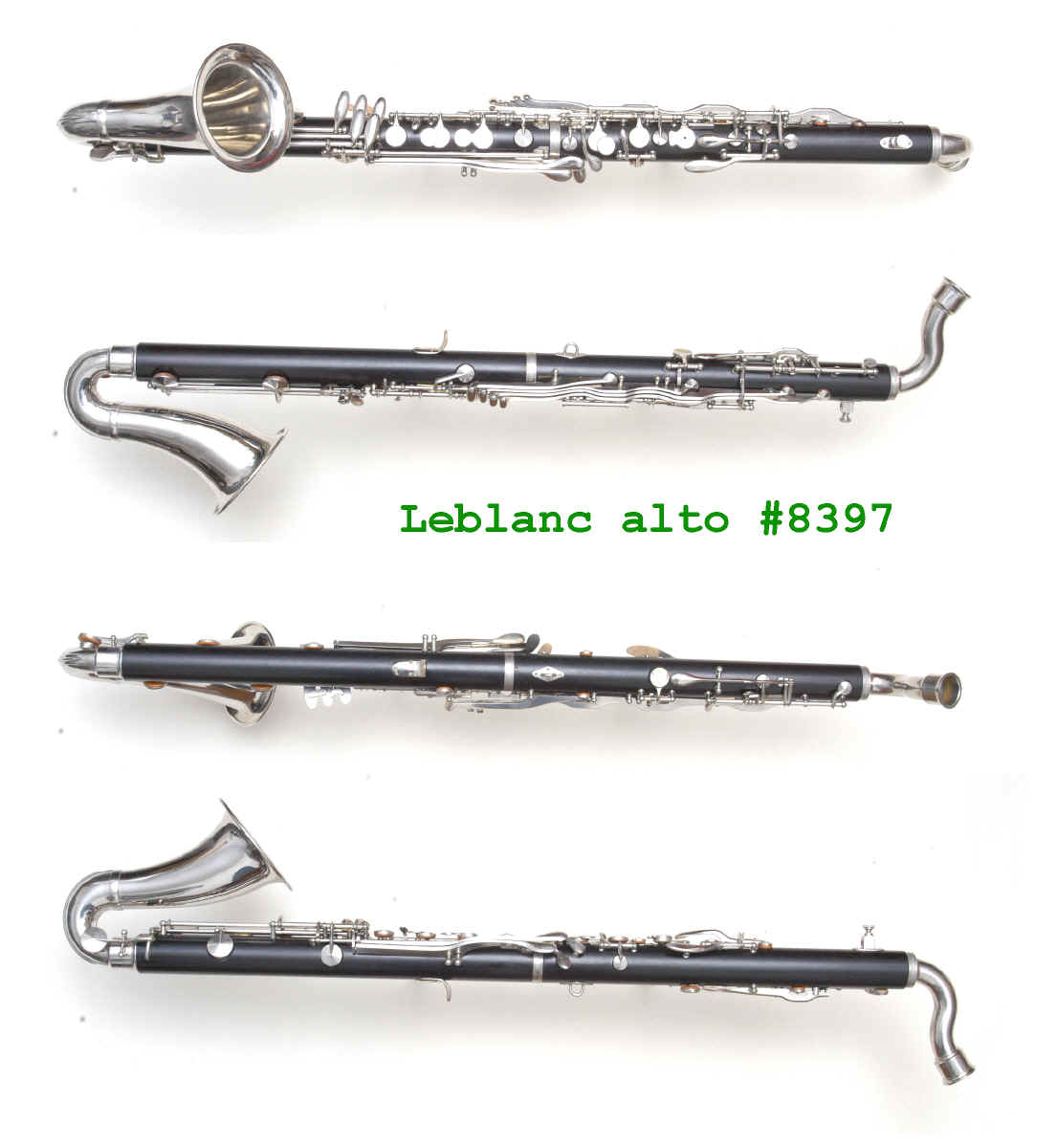
Leblanc pro. Alto - my personal favourite! Warm and gentle, like me. The post 1965 swan neck shortens the instrument for my short arms and the large bore (18mm) is easy to play, with bags of finesse.
The older Leblancs have the conventional straighter stance but they are still smashing to play when in good nick. Earlier ones like this had solid nickel-silver keywork which buffs up nicely but does tarnish over long periods unless rubbed over with a silver cloth. I think it's better on an old instrument than showing patches of plating wear.
Early LeblancA note about Leblanc family altos
My first alto clarinet was a 'Reso-tone' plastic Vito which had been snapped across the middle tenon. Subsequently I repaired quite a few of these, both alto and bass, and very good they were too. I was hard pressed to tell them from the wooden Pro. models I had later. As always a decent mouthpiece works wonders. Vito
Almost the same as the Vito are the Noblets. Like their big brothers pitched in the bass Bb, the alto Noblets are amongst the most popular advanced amateur/semi pro. instruments with good reason. Solid and reliable because of simple robust construction they still have beautiful tone and excellent even intonation. I have refurbished a number of these and every one has been an instrument to give every satisfaction. Noblet
Selmer needs no introduction and although I can't personally get along with the American open hole plastic 'Resotone' Bundys because of their wide hole spacings, there are thousands about which are used in school bands because of their robustness. I wonder how younger players get on with the wide spacings probably forced on them by the attraction of a cheap instrument. Some must be discouraged without realising that their problems are easily solved by a change of instrument.
Bundy
The French wooden Selmers are lovely instruments. Again the finger positions are different to most others, not neccessarily worse but worth looking at in comparison with others. The trill keys are where the biggest difference lies, Selmer being a good 12mm further away from the right hand than Leblanc for example. They have small bore at 17mm which gives a wonderful tone and easy playing across the break but are said to be rather short of power. I have had both the ordinary and the 'Series 9' and cannot tell the difference. Wood selection I suppose, and maybe extra careful setting up from new. Series 9Selmer alto not series 9
Alexandre alto. Never heard the name until I had the bass, then up popped this alto which I had because the bass was impressive. Small bore at 17.2mm and has a good strong vibrant tone, blowing a half a grade easier reed if you know what I mean. Has the wrong bell but tunes OK. I still haven't stripped this one as it is in good condition. One pad and careful regulation has it playing well so it will have to wait until I have nothing better(worse) to do. Alexandre
I had a terrific 1939 open hole Conn which found an enthusiastic home in Switzerland. It had quite a powerful presence with a decent tone but I struggled to span the widely spaced finger holes. It made a good impression though so when I saw three widely different serial numbers on later horns all for sale at the same time, I had to see how they progressed over time. The earliest was made for Conn by Malerne in France when Conn workers were on strike in the 1950's. All three looked virtually identical to each other apart from a nice series of updates to the adjusting screws which I spoiled by adding the 'later' designs to the earlier horns. Conn circa 1955Conn 1965Conn 1969 'Comfortable' to hold and nice to play. The early one was unplated (I like that). I added a couple of adjusting screws to each one to avoid having to bend keys for regulation which is not nice especially as the upper and lower keys are built as stacks, like a flute. i.e. they assemble on a shaft using cotter pins and the whole assembly is then fitted to the body. Bore is 17.3mm, small but not as small as the Selmer. They are all comfortable to play and sound good. Very nice and even through the range but I can't remember the open hole one well enough to compare them. These were certainly easier to finger than the open hole version.
A Buffet alto from 1965. Needed some tlc but with smallish bore it rivalled the Selmers, and the keys fitted me better. A professional grade clarinet but with delicate speaker mechanism linked to the RH3 key. Buffet.
SML King marigaux alto. This had a couple of broken keys, missing ring and pivot, cracks top and bottom, mangled bell, no neck, but apart from that was in great shape. Very Selmer-ish, small keywork, locked posts, appropriate adjusters (one to be added on RH3 bridge adjustment), smallish bore at 17.2mm. This is a strange one! Sounded wonderful when it was finished. Another delicate built up stack design but without the long rods of the Buffet.
SML Marigaux
The wooden Pedlar alto has a soft and smooth sound which gets a bit raspy if you force it; but that could be me or the mouthpiece or both. I have tried 5 MP's with different results but all having the same general character. Bore is 17.6mm.
This clarinet is very comfortable with its rotating trill keys just in the right place and a positive feel from its dished key tops.
Kohlert alto. Smallish bore at 17.5mm and sounds a bit more penetrating than the Leblancs. Easy to play and comfortable to hold
with dished keytops. The first I saw which had the auto speaker changeover operated by LH3 and/or A key. Worked though! A characteristic full tone with low resistance. Had its own slightly smaller mouthpiece size.
Kohlert
I also had to clean up a Thibouville alto which was a nicely made instrument.Thibouville
One which intrigued me was an early 'noname' which had separate speaker keys rather than automatic, a robust system favoured by those with no faith in modern technology.noname